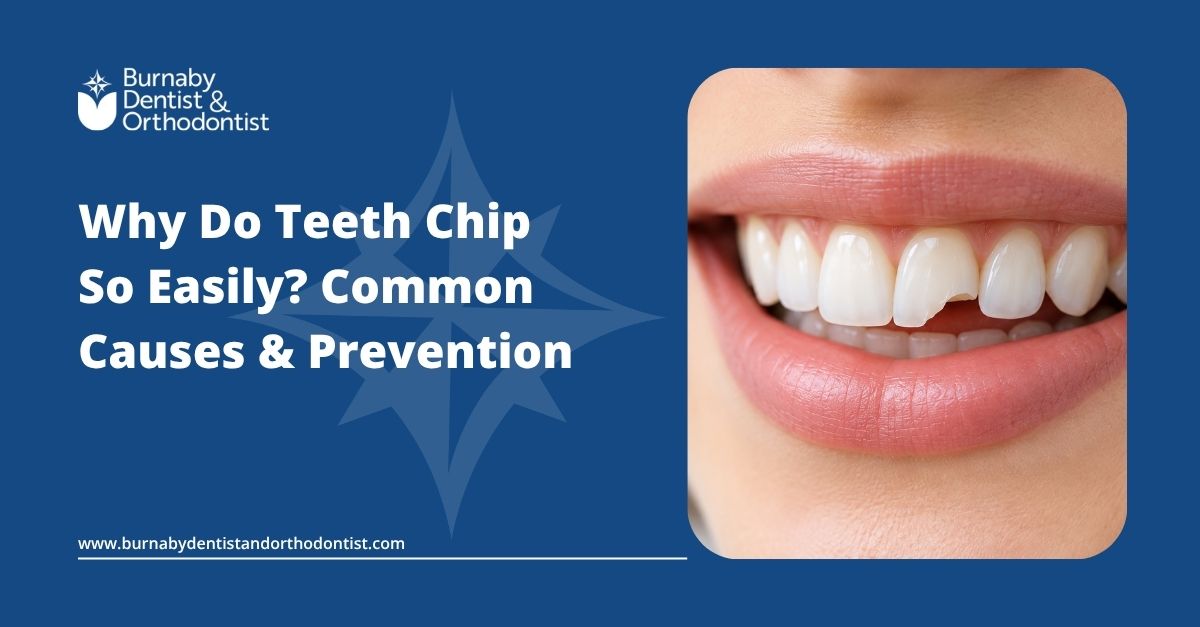
Chipping a tooth while biting into something relatively soft can be surprising, especially when there was no obvious injury. It may leave you wondering, why do teeth chip so easily, and does it mean your teeth are becoming weak?
Teeth can chip when their structure has already been affected by repeated stress, enamel erosion, grinding or clenching, an uneven bite, or existing dental work.
Enamel is extremely hard, but it is not immune to fracture, and it cannot regrow once tooth structure is lost. Sometimes, what seems like a minor biting incident is simply the point when an already stressed area finally breaks.
A single small chip does not necessarily mean there is a serious dental problem. However, repeated chipping, new sensitivity, pain when biting, or damage around an existing filling or crown may indicate an underlying issue worth assessing. Identifying what contributed to the damage can help determine the appropriate repair and reduce the risk of further chipping.
At a Glance:
- Teeth can chip even though enamel is the hardest tissue in the body because hardness does not make enamel immune to cracking or fracture.
- Common contributing factors include grinding or clenching, accumulated tooth wear, decay, acid erosion, existing restorations, trauma, and biting hard foods or objects.
- Teeth do not simply become "brittle" with age, but years of wear, dental work, dentin changes, gum recession, and dry mouth can affect their vulnerability to damage.
- A chip, craze line, and cracked tooth are different. Pain when chewing, significant sensitivity, trauma, or substantial tooth loss warrants more prompt dental assessment.
- Treatment may range from smoothing or composite bonding to an onlay, crown, or root canal treatment, depending on the depth and condition of the tooth.
- Preventing future chips means addressing the underlying contributors, which may include bruxism, acid exposure, dry mouth, dental trauma, or damaging oral habits.
- If your teeth are chipping repeatedly, a dental examination can help identify possible causes and determine whether treatment, monitoring, or preventive care is appropriate.
Enamel is the hardest tissue in your body, so why does it break?
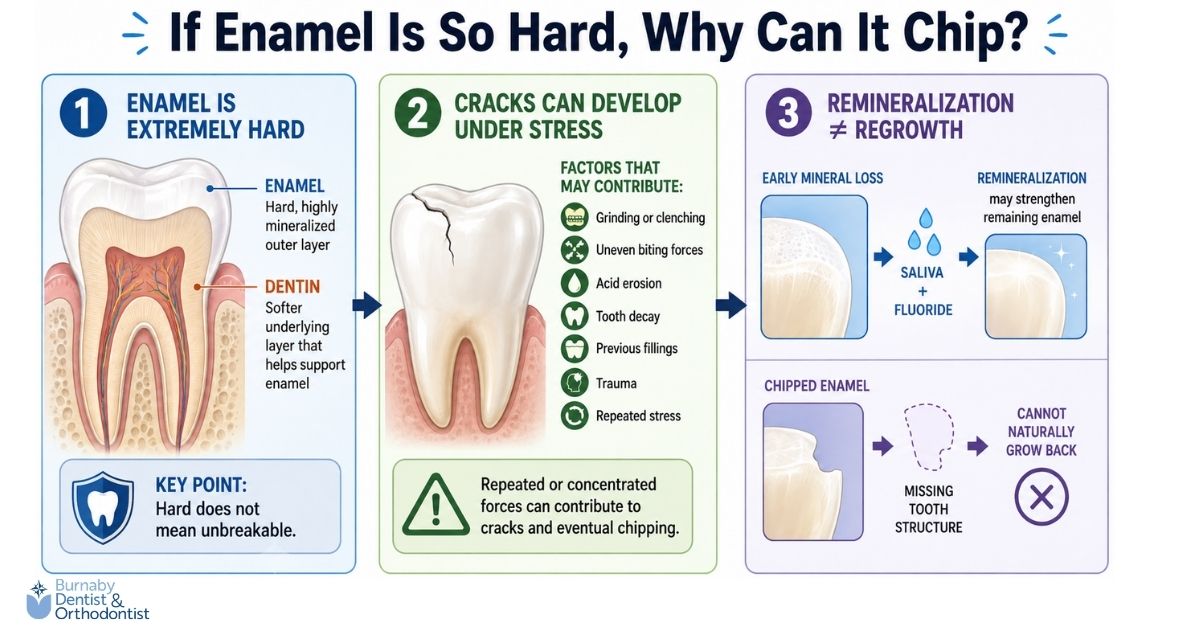
Tooth enamel is the highly mineralized outer layer that protects the underlying dentin and pulp. It is the hardest tissue in the human body, but hardness does not mean it cannot be damaged.
Enamel can still chip or fracture when forces exceed what the tooth can tolerate, particularly when the tooth has already been affected by wear, erosion, decay, previous dental treatment, or repeated biting forces.
Hard is not the same as unbreakable
Hardness describes how well a material resists scratching and surface wear. Resistance to cracking and fracture involves different mechanical properties. Enamel’s high mineral content gives it exceptional hardness, but cracks can still develop and grow when it is exposed to repeated or concentrated stress.
This helps explain why a tooth may appear to chip while eating something that normally would not cause damage. The final bite may not be the only contributing factor. Grinding or clenching, an uneven bite, acid erosion, decay, trauma, or a large existing filling may have already affected the tooth.
Enamel also works together with the underlying dentin and the junction between these two tissues. Dentin is less mineralized than enamel, and the dentin–enamel junction plays an important role in the tooth’s mechanical behaviour, including helping resist the progression of cracks from enamel into dentin.
Enamel cannot repair itself
Unlike bone, mature enamel does not contain living cells capable of rebuilding tooth structure that has been physically lost. Once a piece of enamel chips away, the body cannot naturally grow that missing portion back.
This is different from remineralization. Saliva and fluoride can support the remineralization of enamel affected by early mineral loss, helping strengthen the remaining surface. However, remineralization cannot replace a piece of enamel that has fractured or restore the original shape of a chipped tooth.
For that reason, a new chip can be worth assessing even when it is small and painless. A dentist can evaluate how much tooth structure is involved, look for possible contributing factors or cracks, and determine whether treatment or monitoring is appropriate.

Begin Your Smile Journey With Dr. Sasan Hadianfar
Why are my teeth suddenly chipping? The most common causes
Teeth that seem to start chipping suddenly may have been undergoing changes for some time. Repeated tooth-to-tooth contact, acid-related wear, decay, existing dental work, trauma, and certain habits can all affect tooth structure. In some cases, more than one factor may be involved.
Common factors that may contribute to chipped or damaged teeth include:
- Grinding or clenching: Repetitive tooth-to-tooth contact can contribute to tooth wear and may place additional mechanical stress on teeth and restorations.
- Biting forces: How and where your teeth make contact may be relevant when a dentist investigates repeated damage to particular teeth. Bite relationships are one of several factors that may be considered during an examination.
- Large or aging restorations: Teeth with extensive restorations have less remaining natural tooth structure. Over time, a filling or the surrounding tooth may also develop wear, cracks, recurrent decay, or other changes that warrant assessment.
- Acid-related tooth wear: Repeated exposure to dietary or gastric acids can contribute to progressive loss of dental hard tissue. Sources may include acidic foods and drinks, reflux, or repeated vomiting.
- Decay: Dental caries causes mineral loss and breakdown of tooth structure, which can leave an affected area more vulnerable to damage.
- Chewing hard foods or objects: Biting ice, hard candy, unpopped popcorn kernels, pens, or other hard objects can expose teeth to concentrated forces.
Dental or facial trauma: Falls, sports injuries, accidents, and other impacts can chip or fracture teeth. - Accumulated tooth wear: Tooth wear becomes more common with age and can involve a combination of chemical and mechanical processes.
The cause is not always obvious from looking at a chip alone. Sometimes the activity occurring when a chip is noticed does not fully explain why the tooth fractured. An examination may reveal decay, wear, an existing restoration, or another factor affecting the tooth’s structure.
Repeated chipping also does not automatically mean you have “weak” or “brittle” teeth. A dental examination can help identify possible contributing factors and determine whether the affected tooth needs treatment, monitoring, or preventive care.
Grinding and Clenching: The Cause Most People Never Suspect
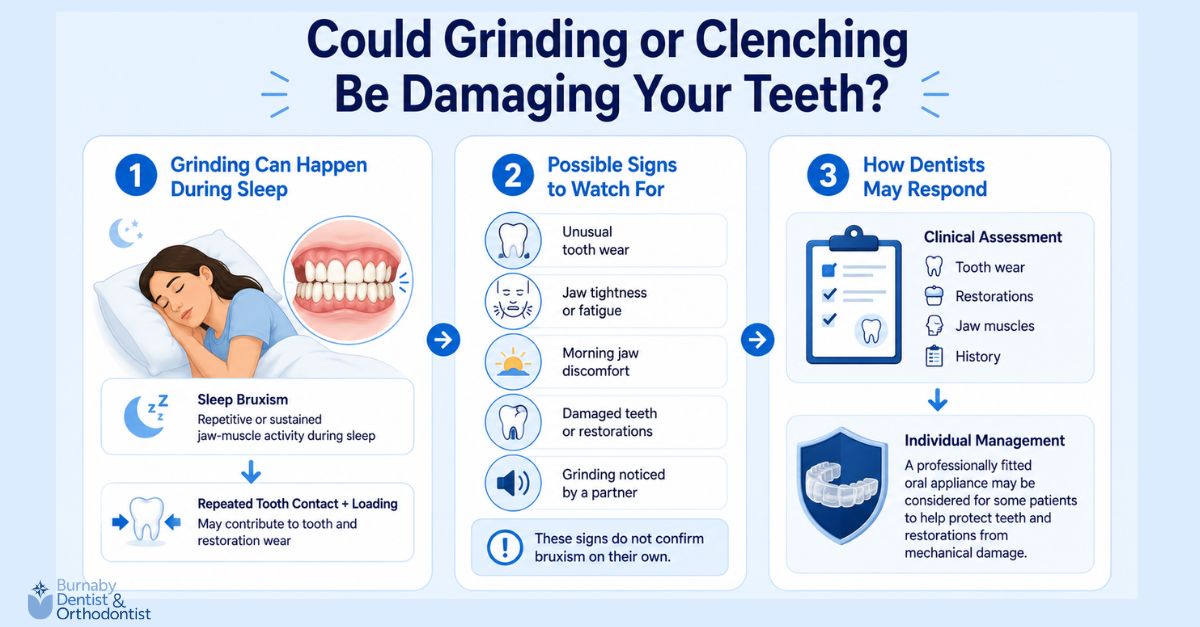
Grinding and clenching are commonly associated with bruxism, which involves repetitive or sustained jaw-muscle activity. Sleep bruxism occurs during sleep, so you may not be aware of it unless someone hears you grinding or a dentist identifies findings that warrant further assessment.
Bruxism does not automatically mean your teeth will chip, and not every chipped tooth is caused by grinding or clenching. However, repeated tooth contact and loading may contribute to tooth wear and can be relevant when a dentist investigates repeated damage to teeth or restorations.
Signs You May Be Grinding in Your Sleep
Possible findings or symptoms associated with sleep bruxism can include:
- Abnormal tooth wear
- Jaw muscle discomfort, fatigue, or tightness
- Morning jaw or facial muscle discomfort
- Damage to teeth or dental restorations
- Grinding sounds reported by a sleeping partner
These findings are not unique to bruxism, so having one or more does not confirm that you grind your teeth. Similar signs can occur because of other forms of tooth wear, problems affecting individual teeth or restorations, or other factors.
A dentist may therefore consider your symptoms, dental and medical history, tooth-wear pattern, condition of existing restorations, and jaw muscles as part of the assessment. In some situations, instrumental methods may also be considered when additional information about sleep or awake bruxism is needed.
If bruxism appears to be contributing to tooth or restoration damage, management depends on the individual findings. The aim is to address the risks identified during the examination rather than assume that grinding is responsible for every chipped or worn tooth.
For some patients, a professionally fitted oral appliance may be considered to help protect teeth and restorations from mechanical damage during sleep. A dentist can determine whether this type of protection is appropriate based on the condition of the teeth, existing dental work, and other clinical factors. However, a night guard should not be presented as a treatment that necessarily stops the underlying bruxism itself.
When Your Bite May Be Contributing to Tooth Damage
The way your upper and lower teeth meet, known as occlusion, is one of several factors a dentist may consider when investigating repeated chipping or tooth wear.
The amount and distribution of biting forces vary considerably from person to person, and tooth position, jaw movement, grinding or clenching, and the condition of existing restorations can all be relevant.
Having a misaligned bite, or malocclusion, does not necessarily mean your teeth will chip. The relationship between occlusion and tooth damage is complex, and research does not support assuming that a particular bite pattern is the cause of wear or fracture without considering other factors.
A closer assessment may be appropriate when damage repeatedly affects the same tooth or restoration, or when particular areas show significant wear. These patterns can provide useful clinical information, but they do not establish the cause on their own.
An occlusal assessment may include examining where the teeth contact when you bite and move your jaw, looking at patterns of tooth wear, and evaluating existing restorations. When clinically appropriate, dental occlusion treatment may be considered based on these findings.
The dentist can consider these findings alongside other possible contributors, such as bruxism, acid-related tooth wear, decay, and previous dental treatment.
Old Fillings, Crowns, and Root Canals: Why Repaired Teeth May Chip
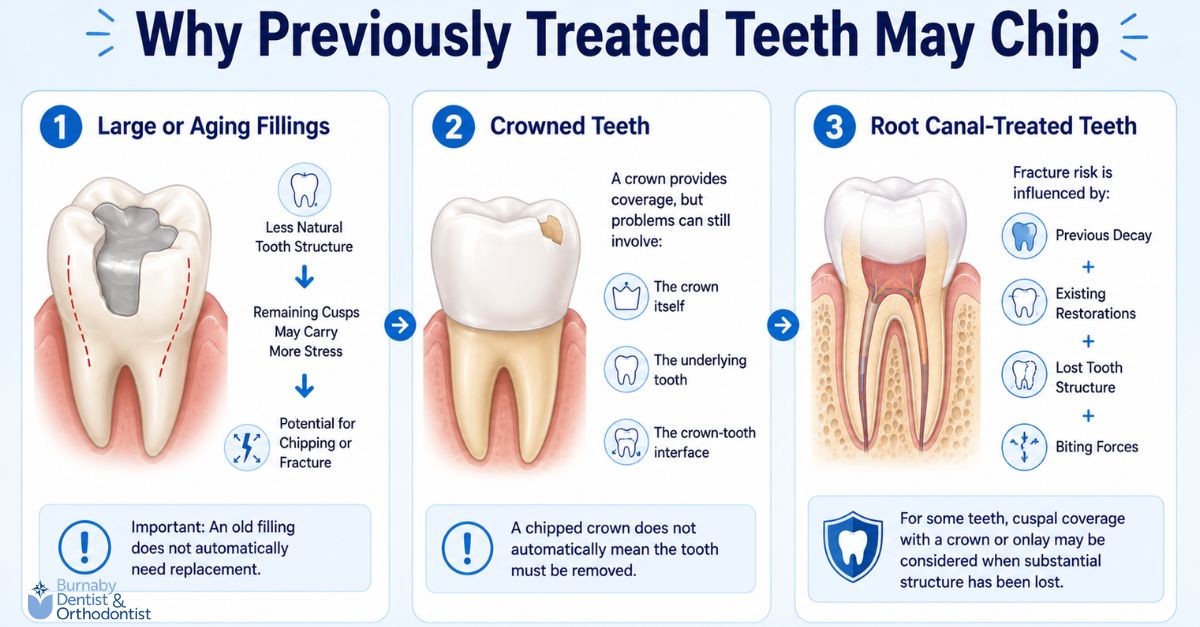
A tooth that has already undergone restorative treatment can sometimes be more vulnerable to fracture, particularly when a substantial amount of natural tooth structure has been lost. This does not mean that fillings, crowns, or root canal treatment automatically make teeth weak.
The risk depends on factors such as how much healthy tooth structure remains, the extent and condition of the restoration, existing cracks or decay, and the forces placed on the tooth.
Large or Aging Fillings
A tooth with a large filling has less natural tooth structure remaining than an intact tooth. Depending on the extent and location of the restoration, the remaining walls or cusps may be more susceptible to fracture under chewing forces.
Both restorations and the surrounding tooth structure can also develop problems over time.
However, an older filling does not necessarily need to be replaced simply because of its age. Its condition and the health of the surrounding tooth should guide that decision.
If a piece of tooth breaks beside an existing filling, a dentist can assess how much healthy tooth structure remains and determine whether a filling, onlay, crown, or another treatment is appropriate.
Can a crowned tooth still chip?
A dental crown covers and restores much of the visible portion of a damaged tooth, but neither the crown nor the tooth beneath it is immune to future problems.
Depending on the crown material and circumstances, a crown can chip, fracture, loosen, or wear over time. Problems can also occur in the natural tooth supporting the restoration. An examination can help determine whether the damage involves the crown, the underlying tooth, or both.
A chipped or damaged crown does not automatically mean that the tooth needs to be removed. Treatment depends on the type and extent of damage and the condition of the remaining tooth.
Why Root Canal-Treated Teeth Need Special Consideration
Root canal-treated teeth are sometimes described as becoming “brittle” because the pulp has been removed, but this explanation is too simplistic.
Their susceptibility to fracture is influenced substantially by how much tooth structure has been lost because of decay, previous restorations, trauma, and the procedures needed to access and restore the tooth. The amount and configuration of healthy tooth structure that remains therefore play an important role in planning the final restoration.
For many root canal-treated back teeth, a restoration that provides cuspal coverage, such as a crown or onlay, may be recommended when significant tooth structure has been lost. However, the appropriate restoration depends on the individual tooth. Some teeth with more remaining healthy structure may be suitable for a more conservative restoration.
If a tooth chips around a large filling or crown, or a root canal-treated tooth loses a piece, a dental assessment can help determine the extent of the damage. The dentist can evaluate the remaining tooth and restoration and recommend repair, replacement, monitoring, or another treatment based on the findings.
Acid Erosion: How Everyday Foods and Drinks Soften Enamel
Repeated exposure to acids can contribute to erosive tooth wear, a gradual loss of dental hard tissue. Because erosion and mechanical wear can interact, affected tooth surfaces may become more susceptible to further wear.
Common sources of dietary acid include:
- Soft drinks, sports drinks, and energy drinks
- Citrus fruits and juices
- Wine
- Carbonated and other acidic beverages
How often your teeth are exposed to acid matters. Frequently consuming acidic foods or drinks can increase the risk of erosive tooth wear. Rinsing with water afterward can help clear acids from the mouth, and it is generally advisable to avoid brushing immediately after significant acid exposure.
Reflux, Dry Mouth, and Medication Side Effects
Acid can also come from inside the body. Gastroesophageal reflux and recurrent vomiting can expose teeth to gastric acid, contributing to erosive tooth wear. Persistent reflux or recurrent vomiting may warrant both dental assessment and appropriate medical follow-up.
Dry mouth, or xerostomia, can also affect the mouth’s natural protective environment. Saliva helps clear and buffer acids and supports remineralization. Medications are among the possible causes of dry mouth and reduced salivary function.
If you suspect a medication is contributing to dry mouth, do not stop taking it without medical advice. A dentist or prescribing healthcare professional can help assess possible causes and appropriate management.
Habits That Chip Teeth More Often Than People Realize
Some everyday habits expose teeth and dental restorations to forces outside normal chewing. These habits do not necessarily cause a tooth to chip every time, but avoiding them can reduce unnecessary stress on your teeth.
Common habits worth avoiding include:
- Chewing ice: Biting ice can crack or damage teeth and restorations.
- Biting hard candy or unpopped popcorn kernels: Unexpectedly hard foods can place substantial force on a tooth and may contribute to cracks or fractures.
- Using your teeth as tools: Opening packages, cutting tags, or similar activities can expose teeth to forces they were not intended to handle.
- Biting pens, pencils, or other hard objects: Repeatedly biting hard objects places unnecessary mechanical stress on teeth and restorations.
- Nail biting: Chronic nail biting can contribute to wear of the front teeth and has been associated with other dental and oral complications.
- Biting very hard foods or objects: Fruit pits, bones, and other hard items can potentially damage teeth or dental restorations.
- Oral piercings: Tongue and lip jewellery can repeatedly contact teeth and gums. Research has associated oral piercings with complications including tooth chipping, dental fractures, tooth wear, and gum recession.
These habits do not affect everyone in the same way. The condition of the tooth matters. A tooth with a large filling, existing crack, decay, substantial wear, or previous damage may tolerate a hard or unusual biting force differently from an intact tooth.
If you notice repeated chipping, simply avoiding hard foods may not address the entire problem. A dental examination can help determine whether a habit is contributing to the damage or whether another factor, such as grinding, acid-related wear, decay, or an existing restoration, should also be investigated.
Do teeth get weaker with age?
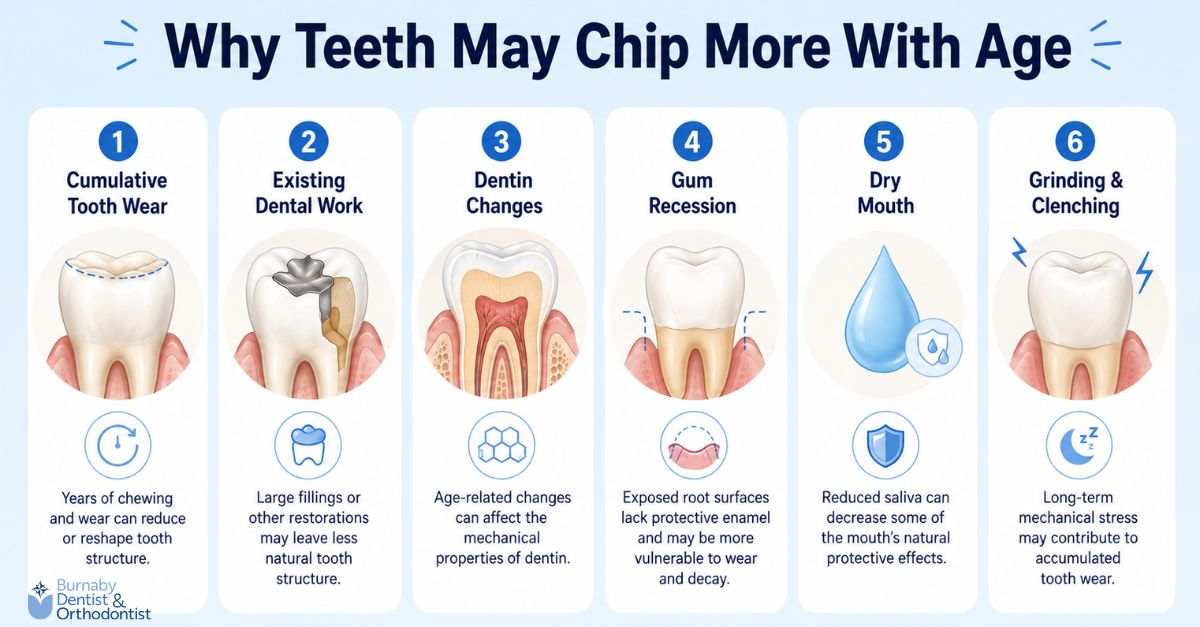
Teeth do not simply become “brittle” with age, but aging can affect the mechanical properties of enamel and dentin, while decades of tooth wear, existing dental work, gum recession, dry mouth, and repeated mechanical or acid-related stress can also increase vulnerability to damage.
Several factors may help explain why chipping becomes more noticeable later in adulthood:
- Cumulative tooth wear can gradually change the shape and amount of remaining tooth structure.
- Existing restorations may mean that some teeth have less remaining natural tooth structure, particularly when restorations are extensive.
- Age-related dentin changes can affect the mechanical properties of the tooth.
- Gum recession can expose root surfaces, which are not covered by enamel and may be more susceptible to wear and decay. When recession is present, a dentist can assess the cause and determine whether monitoring, preventive care, or treatment such as gum grafting may be appropriate.
- Dry mouth can reduce some of saliva’s protective effects. Medications and certain health conditions can contribute to dry mouth.
- Long-term grinding or clenching may contribute to accumulated tooth wear in some people.
Repeated chipping should therefore not automatically be attributed to “weak teeth from aging.” A dentist can assess the pattern of damage and look for contributing factors such as tooth wear, decay, existing restorations, dry mouth, or grinding.
What About Vitamin Deficiencies?
Nutrition is important for oral and overall health, but chipped teeth in adults should not automatically be attributed to a vitamin or mineral deficiency. Tooth damage can have many possible contributors, including mechanical stress, acid-related wear, decay, and existing restorations.
If several teeth begin chipping without an obvious explanation, a dental assessment can help identify possible contributing factors. If the findings or medical history suggest a nutritional or other health concern, appropriate medical follow-up may also be recommended.
Is it a chip, a crack, or just a craze line?
A chip, crack, and craze line describe different types of tooth damage. A chip generally means that a piece of tooth structure has broken away. A craze line is a shallow line limited to the enamel, while a cracked tooth involves a more significant crack that can extend into deeper tooth structure.
Chip vs. Crack vs. Craze Line: Key Differences | |||
|---|---|---|---|
| Type | What It Means | Possible Signs | Why Assessment Matters |
| Chip | A Piece of Tooth Structure Has Broken Away | Rough or Sharp Edge, Visible Missing Piece, Possible Sensitivity | The Size, Depth, and Location Help Determine Whether Treatment Is Needed |
| Craze Line | A Shallow Line Involving the Enamel | Fine Visible Line, Usually Without Symptoms | Craze Lines Generally Do Not Affect the Tooth’s Structural Integrity, Although They May Be an Aesthetic Concern |
| Fractured Cusp | Part of a Chewing Cusp Has Fractured, Sometimes Around a Restoration | A Portion of a Molar or Premolar May Feel Loose or Break Away | The Extent of the Fracture and Condition of the Remaining Tooth Influence Treatment |
| Cracked Tooth | A Crack Extends From the Crown Into Dentin and May Progress Farther Into the Tooth | Symptoms Can Include Intermittent Pain When Chewing or Sensitivity to Temperature | The Location and Extent of the Crack Help Determine Treatment Options and Prognosis |
Cracked teeth can be difficult to identify because symptoms vary. Some remain asymptomatic for a period of time, while others cause intermittent discomfort when chewing or sensitivity to temperature. Pain associated with biting or releasing biting pressure can be a clinical clue, but no single symptom confirms that a tooth is cracked.
Dentists may use a combination of dental history, visual examination, magnification, bite testing, periodontal probing, transillumination, and appropriate dental imaging when investigating a suspected crack. Cracks are not always clearly visible on conventional dental X-rays, which makes the clinical examination particularly important.
If you are unsure whether a visible line or damaged edge is a craze line, a small chip, or a deeper crack, a dental assessment can help determine what is present and whether treatment or monitoring is appropriate.
Is a chipped tooth a dental emergency?
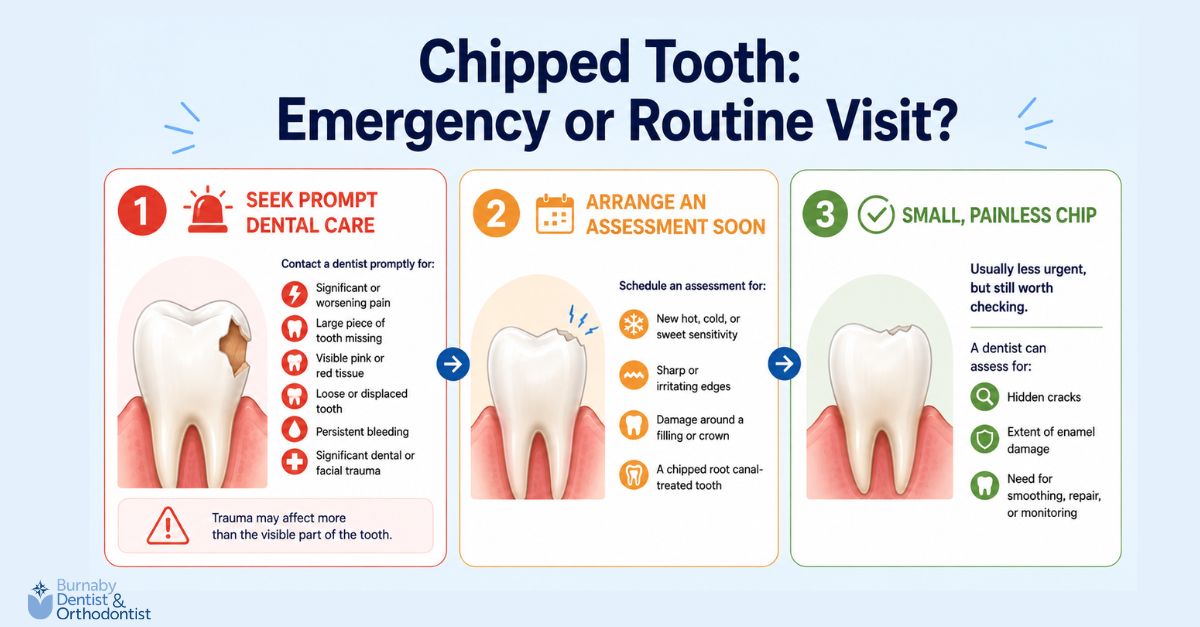
A chipped tooth is not always a dental emergency, but the urgency depends on how much tooth structure was lost, whether the tooth was injured by trauma, and whether you have pain, bleeding, sensitivity, or looseness. A small painless chip can often be assessed at a scheduled dental visit, while more significant injuries may require prompt care.
Seek Prompt Dental Care
Contact a dentist promptly if:
- You have significant or worsening tooth pain.
- A large portion of the tooth has broken away.
- You can see pink or red tissue inside the damaged tooth, which may indicate that the pulp is exposed.
- The tooth is loose or has been displaced after an injury.
- There is bleeding around the injured tooth that does not settle.
- The chip occurred as part of significant dental or facial trauma.
Traumatic dental injuries sometimes involve more than the visible chip. The pulp, root, supporting bone, or surrounding tissues may also be affected, so timely examination can be important even when the full extent of the injury is not immediately apparent.
Arrange an Assessment Soon
A chip may not require emergency treatment but should still be assessed soon if it causes new sensitivity to hot, cold, or sweets, has a sharp edge that irritates your tongue or cheek, or involves an existing filling, crown, or root canal-treated tooth. These features can help a dentist determine how much tooth structure is involved and whether further treatment is appropriate.
Small, Painless Chips
A very small chip limited to enamel and causing no pain or sensitivity is generally less urgent. However, it is still worth mentioning at your next dental visit. A dentist can confirm that the damage is superficial, check for an underlying crack or other contributing factor, and determine whether smoothing, repair, or monitoring is appropriate.
If you are uncertain how serious the damage is, particularly after trauma, contacting a dental office for guidance is reasonable rather than trying to judge the depth of the injury yourself. You can also visit help me with tooth pain or an emergency page for information about seeking care at our practice.
How Dentists Repair a Chipped Tooth
How a dentist repairs a chipped tooth depends on the size and location of the damage, how much healthy tooth structure remains, the condition of the pulp, and whether a deeper crack is present.
Some small chips need only minor treatment, while more extensive fractures may require a restoration that provides greater coverage and protection.
Chipped Tooth Severity and Possible Treatment Options | ||
|---|---|---|
| Type of Damage | Possible Treatment | When It May Be Considered |
| Very Small Enamel Chip | Smoothing, Bonding, or Monitoring | A minor chip with adequate remaining tooth structure and no deeper injury |
| Small to Moderate Chip | Composite Bonding | Tooth-coloured resin may be used to rebuild missing enamel or dentin |
| Larger Front-Tooth Damage | Bonding, Fragment Reattachment, Veneer, or Another Restoration | The choice depends on the extent and location of damage, remaining tooth structure, bite, and aesthetic considerations |
| Damaged Cusp or Larger Structural Loss | Onlay or Crown | May be considered when greater coverage or protection of the remaining tooth is needed |
| Fracture With Pulp Exposure | Vital Pulp Treatment or, When Indicated, Root Canal Treatment | Treatment depends on factors such as pulp status, fracture characteristics, root development, and the ability to restore the tooth |
| Severely Fractured Tooth | Assessment for restoration or extraction | Options depend on the location and extent of the fracture and whether the tooth can be restored |
For a minor cosmetic chip, dental bonding may be used to rebuild the missing area. Larger chips may require an onlay, dental crown, or, in selected front-tooth cases, a veneer. Reattaching the original tooth fragment may also be possible after some injuries.
A chipped tooth or pulp exposure does not automatically mean a root canal is needed. Depending on the injury and condition of the pulp, vital pulp treatment may be an option. Root canal treatment may instead be recommended when the pulp cannot be predictably maintained.
The same applies to extraction. Even a significantly chipped or cracked tooth may have restorative options, depending on the extent and location of the damage.
A dentist can assess the fracture, remaining tooth structure, pulp and periodontal health, bite, and possible underlying cracks to determine which treatment options are appropriate.
If you are dealing with more extensive damage, our help me fix missing or broken teeth page outlines additional care pathways available at our practice.
How to Prevent Teeth From Chipping in the Future
Preventing chipped teeth starts with identifying what may be contributing to the damage. The appropriate approach can differ depending on factors such as grinding, acid-related wear, existing dental work, trauma, dry mouth, or everyday habits.
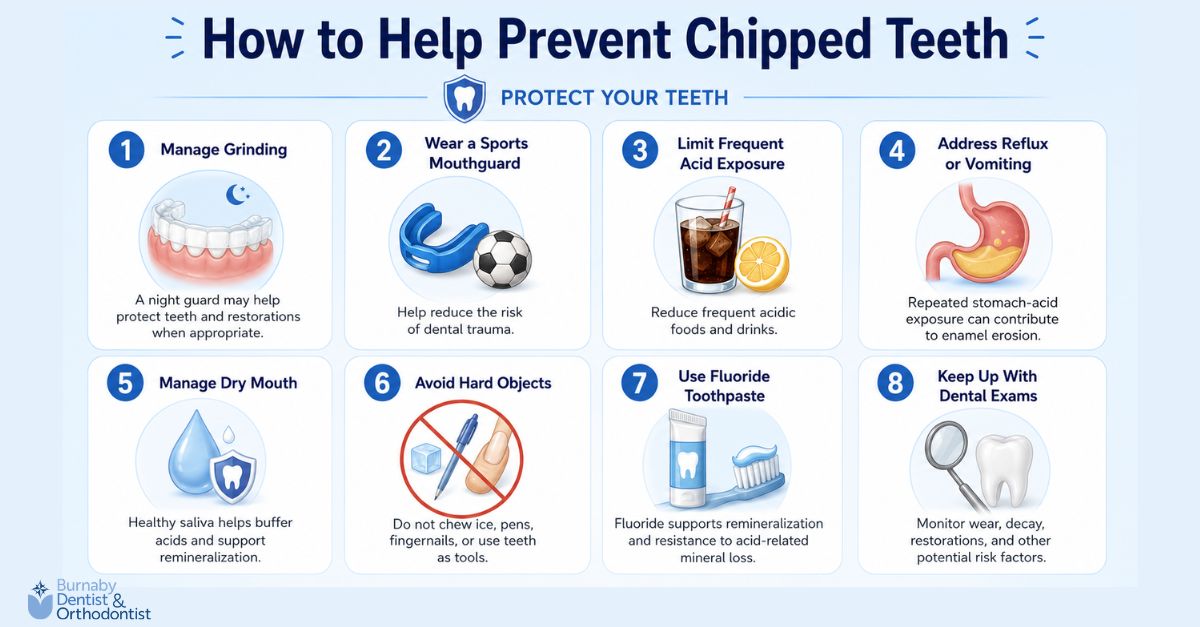
Steps that may help protect your teeth include:
Protect teeth from grinding: If bruxism is associated with tooth wear or damage, a dentist may recommend a night guard to help protect the teeth and restorations. A night guard does not necessarily stop the underlying bruxism.
Wear a mouthguard during sports: A properly fitted mouthguard can reduce the risk and severity of sports-related dental injuries.
Reduce frequent acid exposure: Limiting frequent acidic foods and drinks can help reduce erosive tooth wear. Rinsing with water rather than brushing immediately after significant acid exposure may also help.
Address reflux or recurrent vomiting: Gastric acid can contribute to tooth erosion. Persistent reflux or recurrent vomiting may warrant both dental and appropriate medical assessment.
Manage persistent dry mouth: Saliva helps protect teeth by clearing and buffering acids and supporting remineralization. A dentist or healthcare professional can help investigate persistent dry mouth and recommend appropriate management.
Avoid chewing hard objects: Biting ice, pens, fingernails, and other hard objects or using teeth to open packaging can expose teeth and restorations to unnecessary forces.
Brush with fluoride toothpaste: Fluoride helps make enamel more resistant to acid-related mineral loss and supports remineralization.
Maintain regular dental examinations: Dental visits provide an opportunity to identify and monitor tooth wear, decay, damaged restorations, and other factors that may increase the risk of further damage.
If several teeth have already chipped, prevention should focus on identifying possible contributing factors rather than simply repairing each new chip. A dental examination can help determine which preventive measures are appropriate for your teeth.
How Burnaby Dentist & Orthodontist Diagnoses and Treats Chipped Teeth
At Burnaby Dentist & Orthodontist, we can assess both the damaged tooth and factors that may have contributed to the chip. An examination may consider the amount of tooth structure lost, existing fillings or crowns, decay, tooth wear, and how the teeth come together. When a crack is suspected, bite testing, transillumination, or dental imaging may also be appropriate.
Treatment for chipped tooth repair depends on the findings. Minor chips may sometimes be smoothed or repaired with composite bonding, while more extensive structural damage may require an onlay, crown, or, in selected front-tooth cases, a veneer. We can also assess aging or extensive restorations when the surrounding tooth has chipped or fractured.
When grinding, bite forces, or tooth position may be contributing, we can evaluate the occlusion and consider options such as a custom night guard, bite-related treatment, or orthodontic care when clinically appropriate. Custom sports mouthguards may also help reduce the risk of dental trauma during athletic activity.
For teeth affected by acid-related wear or other enamel concerns, preventive care may include fluoride-based strategies and monitoring.
For chips accompanied by significant pain, sensitivity, trauma, or substantial tooth damage, prompt assessment may be appropriate. Our dental emergency service in Burnaby is available for dental injuries and other concerns that may require timely care.
Even a small, painless chip can be examined to determine whether repair or monitoring is recommended. If you would like to arrange an assessment, contact us to schedule a visit with Burnaby Dentist & Orthodontist.
The Bottom Line: A chipped tooth is a warning sign worth investigating
A chipped tooth does not always mean there is a serious problem, but it can be a sign that the tooth has been affected by wear, grinding, acid erosion, decay, an existing restoration, or repeated mechanical stress.
Small, painless chips may only need monitoring or minor repair, while deeper fractures, pain, sensitivity, trauma, or repeated chipping deserve closer assessment. The important step is identifying why the tooth chipped, not simply repairing the missing piece.
If you have noticed a new chip or your teeth seem to be chipping more often, Burnaby Dentist & Orthodontist can assess the damaged tooth and possible contributing factors.
This article is for educational purposes only and is not a substitute for an in-person dental examination or individualized professional advice.
Why do teeth chip so easily?

Teeth may chip due to grinding, tooth wear, acid erosion, decay, trauma, or extensive restorations. Enamel is very hard but can still fracture under certain forces. Repeated chipping may indicate an underlying factor worth assessing.
Why are my teeth suddenly chipping?
Sudden chipping may reflect changes that developed gradually, such as wear, grinding, acid exposure, decay, or problems around existing restorations. A comprehensive dental examination can help identify possible contributing factors.
Can a chipped tooth heal on its own?
No. Once enamel or dentin has physically broken away, the missing tooth structure cannot regrow. Remineralization can strengthen early demineralized enamel, but it cannot replace a piece that has chipped off.
Does a small chip in a tooth need to be fixed?
Not always. A small, painless enamel chip may only need smoothing or monitoring, while other chips may require bonding or another restoration. A dentist can determine whether treatment is appropriate.
Can stress and grinding cause teeth to chip?
Bruxism, which includes grinding and clenching, can contribute to tooth wear and mechanical stress. Stress may be associated with awake bruxism in some people, but grinding is only one of several possible contributors to chipped teeth.
What vitamin deficiency causes teeth to chip?
There is no single vitamin deficiency responsible for most chipped teeth in adults. Although adequate nutrition supports dental health, chipping is often associated with factors such as wear, acid exposure, decay, trauma, or existing restorations.
How do dentists fix a chipped tooth?
Treatment depends on the extent and location of the damage. Options may include smoothing, composite bonding, a veneer, an onlay, or a crown. Deeper damage involving the pulp may require additional treatment.
How can I stop my teeth from chipping?
Prevention depends on the cause. It may include managing grinding, using a sports mouthguard, limiting frequent acid exposure, addressing dry mouth or reflux, avoiding hard-object chewing, and maintaining regular dental examinations.