

Noticing small “bumps” on your teeth after starting Invisalign® can feel surprising, but they are usually a normal part of treatment. These bumps are called Invisalign® attachments.
Attachments are small, tooth-coloured shapes placed on specific teeth to help aligners grip better and guide tooth movement more precisely. They are temporary, not used in every case, and are removed when they are no longer needed.
At a Glance:
Invisalign® attachments are small, tooth-colored shapes that may be used during treatment to help aligners move teeth more precisely. They are temporary, not used in every case, and are typically removed at the end of treatment with care to preserve enamel.
At Burnaby Dentist & Orthodontist, attachments are used selectively as part of a customized Invisalign® plan, with a focus on clear planning, ongoing monitoring, and careful placement and removal with attention to enamel preservation.
Invisalign® Attachments Explained: What They Are, Why You Have Them, and Whether They’re Necessary
Attachments help clear aligners apply more controlled pressure to specific teeth. Their use depends on the movements planned in your Invisalign® treatment.
What Invisalign® Attachments Are
Invisalign® attachments are small, tooth-colored shapes made from composite resin that are temporarily bonded to certain teeth. They are designed to work with clear aligners by helping guide tooth movement in a more controlled way during treatment.
These attachments are placed in specific positions based on a digital treatment plan and are not randomly added. Each one is selected to support a planned movement for a particular tooth.

Why They Are Used During Invisalign® Treatment
Invisalign® aligners are made from smooth, flexible plastic. On their own, they can apply gentle and consistent pressure to teeth. However, some tooth movements are more complex and may require additional control.
In those situations, attachments can help the aligners:
- Improve grip on specific teeth
- Apply force in more targeted directions
- Support movements such as rotation or tipping control
- Follow the planned sequence of tooth adjustments more closely
Not every case requires attachments, and their use depends on how your teeth are expected to move throughout treatment.
What They Look and Feel Like

Attachments are designed to blend in with your teeth as much as possible. They are:
- Small in size
- Custom-shaped for each tooth
- Matched closely to tooth color
At first, you may notice them slightly with your tongue or feel a mild change in texture when you bite or speak. Some patients find that this becomes less noticeable over time as they adjust.
Are Invisalign® attachments necessary for everyone?
Attachments are not required for every Invisalign® case. Some patients complete treatment without them, while others may need several, depending on the complexity of tooth movement.
Their use is based on clinical planning rather than appearance or preference alone. In many cases, they are considered when additional precision or control is needed to help guide treatment progress.

Begin Your Smile Journey With Dr. Sasan Hadianfar
Are Invisalign® attachments normal — or a sign something’s wrong?
Seeing attachments is usually a normal part of treatment planning. In fact, their presence often reflects that your case has been digitally mapped and customized.
They are not typically a sign that something is wrong. Instead, they may indicate that your orthodontic plan includes more detailed tooth movements that require added control.
However, every case is different. Some patients never need attachments, while others may need several.
Why Invisalign® Uses Attachments to Move Teeth More Precisely
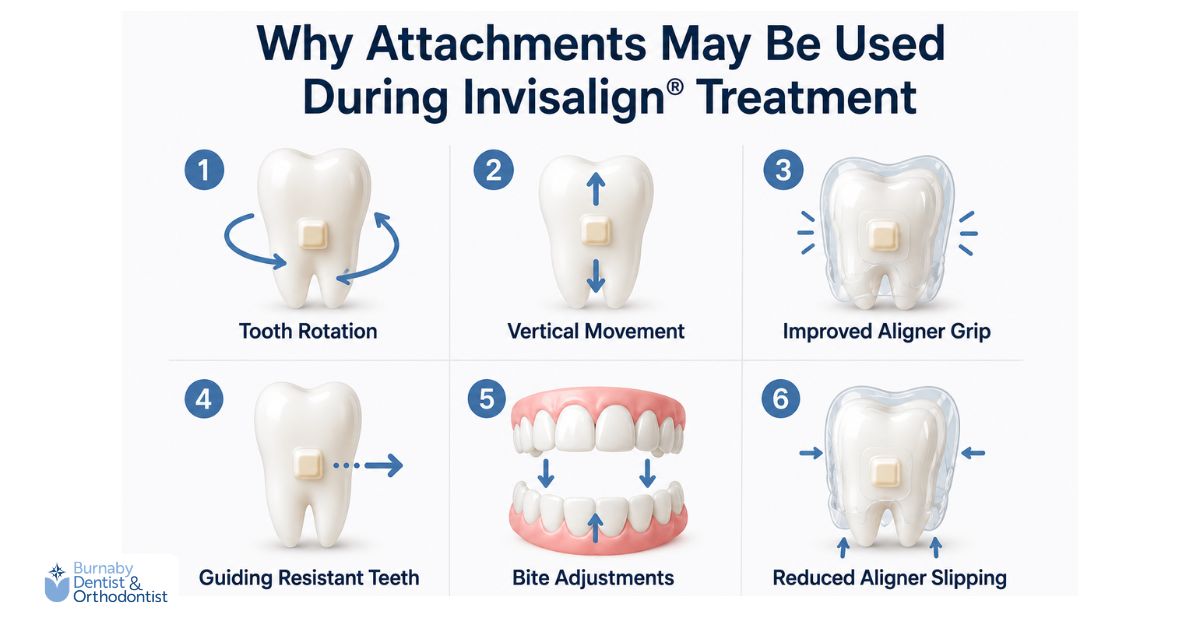
Invisalign® aligners can guide many tooth movements on their own, especially in simpler cases. However, some movements require more control than smooth plastic alone can provide. This is where attachments may be used as part of a planned treatment approach.
Attachments help aligners apply force more precisely to certain teeth, supporting movements that may be harder to guide with smooth plastic alone.
They are commonly used to support:
- Rotating teeth that are turned or misaligned
- Moving teeth vertically or adjusting their angulation
- Improving aligner grip during more complex movements
- Guiding teeth that are more resistant to movement
- Supporting bite adjustments and alignment refinements
- Reducing the chance of aligners slipping during treatment
Because of this added control, attachments may support treatment planning for a wider range of tooth movements. They can help guide more complex tooth movements with clear aligners rather than relying only on traditional braces.
Without attachments, some movements may be harder to guide predictably with aligners alone. In contrast, their use can help support more predictable tracking with the planned treatment stages, depending on the individual case.
What Invisalign® Attachments Look and Feel Like (What’s Normal vs Not)
Invisalign® attachments are designed to blend in with your natural teeth while still serving a functional role in treatment. Most patients become familiar with them fairly quickly, but the first few days can feel a bit different.
What they look like:
- Tooth-colored and usually very close to the natural enamel shade
- Small and slightly raised on the surface of the tooth
- More noticeable in some cases, depending on tooth position, especially on front teeth
What they feel like:
During the initial adjustment period, it is common to notice:
- Slight texture changes when your tongue touches them
- Mild changes in speech or bite awareness
- Light cheek or lip awareness as your mouth adapts
These sensations typically become less noticeable as you adjust over the first few days to a week.
What is not typically expected:
What’s generally considered not typical is persistent sharp pain, irritation that worsens over time, or anything that feels concerning. These are worth checking with your dental provider.
Do Invisalign® attachments damage enamel or leave marks?
A common concern is whether Invisalign® attachments can affect enamel or leave lasting marks on teeth.
When placed and removed appropriately, attachments are generally considered a non-invasive part of treatment. The process involves light surface preparation and composite bonding without drilling into the tooth structure.
A tooth-coloured composite is then bonded in place, and at the end of treatment, it is carefully polished off to minimize changes to the tooth surface when removed carefully and professionally.
Research on attachment removal methods suggests that different finishing tools can vary in how they interact with the enamel surface.
Some polishing systems have been shown to balance efficiency with enamel preservation better, often producing smoother enamel surfaces compared to more abrasive instruments when used in controlled clinical settings.1
The aim is to support tooth movement while preserving enamel as much as possible. In many cases, noticeable long-term changes are not expected when attachments are placed and removed carefully, although individual factors such as oral hygiene, enamel condition, and clinical technique can influence outcomes.
At Burnaby Dentist & Orthodontist, attachment placement and removal are performed with an emphasis on enamel preservation and careful finishing as part of routine orthodontic care.
Invisalign® With Attachments vs Without: What’s the Difference in Results?
Invisalign® cases vary in complexity, which is why attachments are used in some situations and not in others.
When Invisalign® May Work Without Attachments
Not every Invisalign® case requires attachments. In simpler alignment situations, aligners alone may be enough to guide tooth movement. These cases often involve more straightforward adjustments, and the treatment can appear more discreet.
When Attachments are Included in Treatment
In other cases, attachments are added when more complex or multi-directional tooth movements are needed. They can help support more controlled force application, especially when teeth need to rotate, shift vertically, or move in ways that require additional guidance beyond smooth aligner pressure.
How This Can Influence Treatment Outcomes
Attachments are not about making treatment “better” or “worse,” but about supporting what has been digitally planned for your specific case. Depending on the situation, they may help improve control during certain stages of movement and allow a wider range of tooth movements to be managed with aligners.
Ultimately, whether attachments are used comes down to your individual treatment plan and what is considered appropriate for achieving planned tooth movement.
How Invisalign® Attachments Are Placed, Adjusted, and Removed
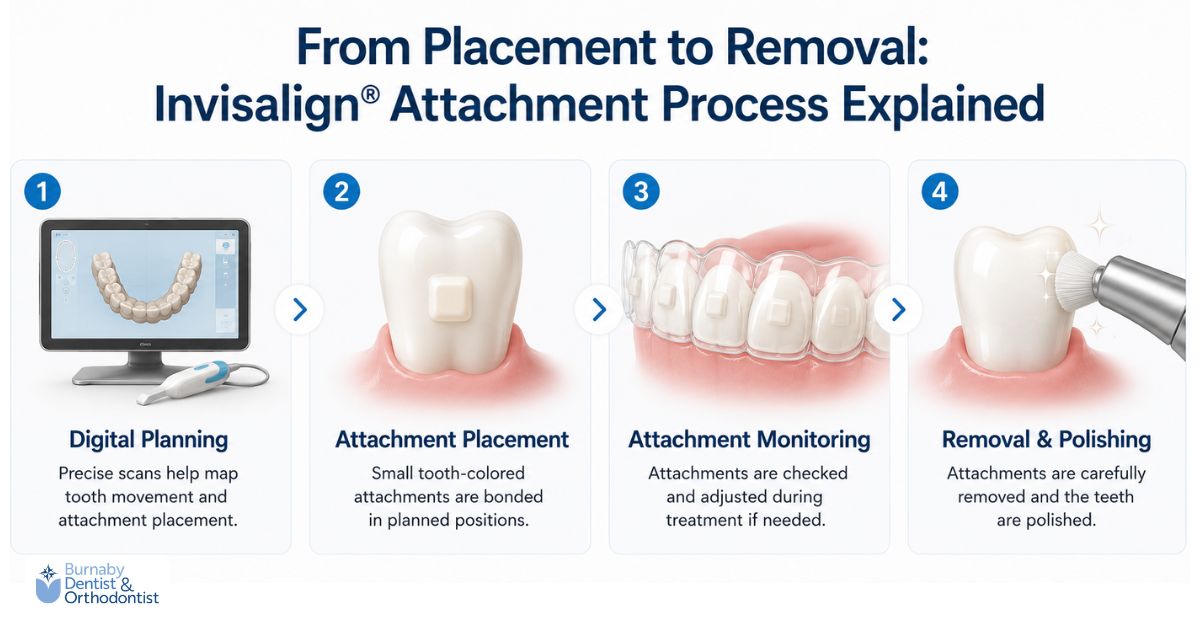
At Burnaby Dentist and Orthodontist, the process of placing, monitoring, and removing Invisalign® attachments follows a carefully planned clinical sequence, including:
Digital Planning and Preparation
We start with a precise digital scan using an iTero scanner, and in some cases, we may also use digital X-rays to support detailed treatment planning as part of our dental exams and diagnostics approach. This helps us map tooth movement and decide where attachments may be useful.
Before placement, the teeth are cleaned and lightly prepared with a conditioning gel to allow proper bonding of the attachment material.
Attachment Placement Process
Once the teeth are prepared, we apply a small amount of bonding agent to help secure the attachments. A tooth-colored composite resin is then placed either directly or using a template aligner designed with pre-set attachment spaces.
We position the template over your teeth and apply gentle pressure so the material bonds in the correct locations. A special curing light is then used to harden the composite and secure the attachments in place. Any excess material is carefully removed, leaving a smooth finish.
In many cases, multiple attachments can be placed during the same appointment.
During Treatment
Once placed, attachments usually stay on for the duration of treatment, although they may be adjusted or replaced if needed to support tooth movement and aligner fit.
We also guide you on how to insert and remove your aligners comfortably at this stage.
Removal After Treatment
When Invisalign® treatment is complete, attachments are removed in a controlled and careful manner. We use professional finishing and polishing instruments to carefully remove the composite material from the tooth surface.
After removal, the teeth are polished to ensure a smooth finish and to remove any remaining bonding residue. This step is done with attention to preserving enamel and restoring the natural tooth surface as much as possible.
It is important that attachment removal is done professionally, as attempting to remove them at home can risk enamel damage or surface irritation.
Common Invisalign® Attachment Myths That Cause Unnecessary Anxiety
Misunderstandings about Invisalign® attachments are common, especially when they first become visible during treatment. Clarifying a few of these concerns can help make the process feel more predictable and less worrying.
“They are permanent”
Invisalign® attachments are temporary and are removed once treatment is complete.
“They damage teeth”
When placed and removed properly, attachments are generally considered enamel-safe. The process is designed to be conservative, although individual enamel condition and clinical factors can vary from case to case.
“They mean something is wrong”
Attachments are not a sign of a problem. In many cases, they are part of a planned treatment strategy used to help guide specific tooth movements more precisely.
“Invisalign® doesn’t work without them”
Not all cases require attachments. Some treatments can progress without them, while others may benefit from their use depending on how the teeth need to move.
How Burnaby Dentist & Orthodontist Uses Attachments to Support Invisalign® Treatment Planning
At Burnaby Dentist & Orthodontist, Invisalign® treatment is planned with a focus on clarity, comfort, and ongoing monitoring as part of a cosmetic dental solution in Burnaby. Attachments are used selectively, based on what is appropriate for each individual case.
We begin with digital smile planning to map tooth movement and determine whether attachments may help improve control. When used, they are placed carefully and only where needed, while attachment-free options may be considered for simpler cases.
Progress is monitored throughout treatment to ensure teeth are moving as planned. At the end, attachments are removed using careful techniques aimed at preserving enamel and restoring a smooth tooth surface, with clear guidance provided to patients at every stage.
The Bottom Line: Invisalign® Attachments Are Temporary Tools for Planned Tooth Movement
Invisalign® attachments may look unusual at first, but they are typically a temporary and planned part of treatment.
In many cases, they are used to help guide tooth movement with more control, especially when aligners alone may not provide enough precision.
Not every patient will need them, but when they are used, it often reflects a more customized treatment approach. They are removed at the end of treatment with care taken to preserve the natural tooth surface.
For patients in Burnaby and nearby areas like Metrotown, Brentwood, Deer Lake, and South Slope, Burnaby Dentist & Orthodontist offers Invisalign® treatment with detailed planning and ongoing monitoring.
Contact:
3999 Kingsway, Burnaby, BC V5H 1Y8
+1 604-437-7723
info@burnabydentistandorthodontist.com
A consultation can help you better understand what to expect based on your individual treatment plan.